

This post may contain affiliate links. Disclosure here.
The perfect after school routine doesn’t exist. I don’t mean to sound negative, it’s simply an observation from spending years trying to craft the best one for our daughter. And while we have found something that definitely works now, it was a struggle, because I quickly realized that what works for one kid, may not work for the other. And that was the case with our Skye, who has moderate to severe ADHD and ODD.
After school used to be the worst part of our day.
I’d pick Skye up full of enthusiasm and she’d give me nothing. She wasn’t trying to be difficult, I think she was genuinely just spent. She’d used up every bit of focus and self-control she had on six hours of sitting still, following instructions, managing friendships, and by the time she got in the car, there was literally nothing left.
I’ve heard this referred to many times as “masking”. Something that many parents to neurodivergent kids may be familiar with.
After-school restraint collapse, or “masking” as we know it, is what happens when a child spends all day holding themselves together from following rules, staying in their seat, processing noise and social pressure, and then gets home to somewhere safe and finally lets it out. For kids with ADHD, the effort required to do this is significantly higher than for neurotypical children.
School is not designed for ADHD brains, and this is something that I’m constantly considering, but it’s a topic I will leave for another day…
Skye’s version of “masking” looks quiet. She doesn’t come in and throw things (most days), and she goes silent, gives one-word answers, and gets snappy if I push too hard. Other kids do the opposite by having a full meltdown the second they walk through the door. Both are the same thing.
Once I stopped reading her silence as attitude and started reading it as exhaustion, I stopped fighting the first hour home.
I stopped trying to make the after-school hours productive straight away, and started treating them as a recovery period, and the afternoons got genuinely easier. Here’s what that looks like for us, but as I’ve said, this may look different in your home.
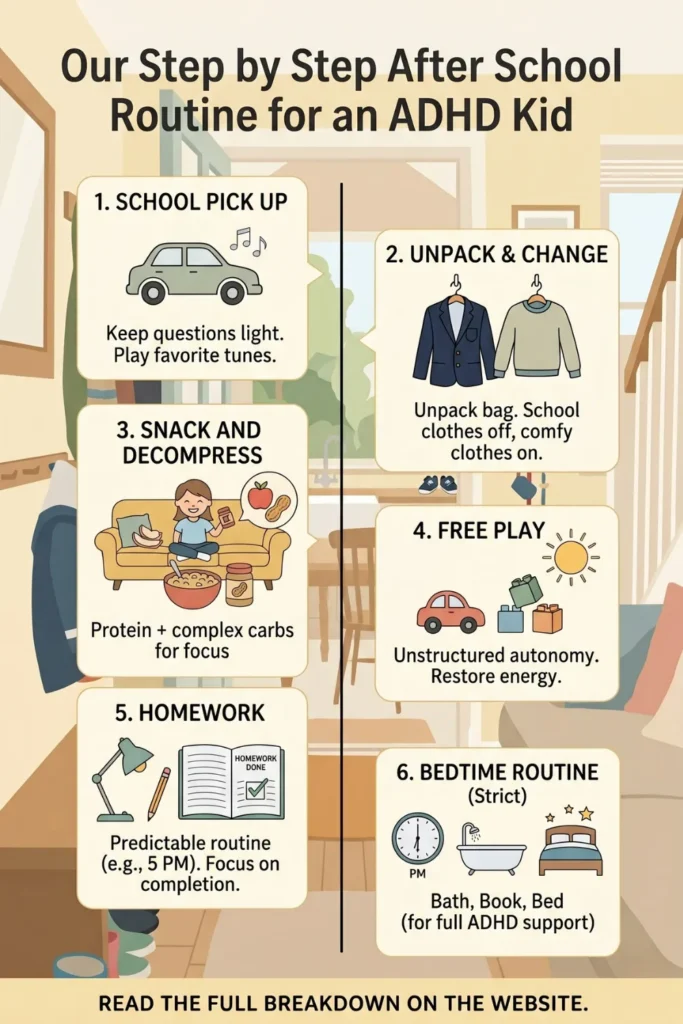
Our After School Routine, Step by Step (What Actually Happens in Real Life)
School Pick Up
I still ask questions on the way home, but I keep them light and take the hint when it’s clear that she doesn’t want to engage. Now we’ll put on music she likes, or we just drive. If she wants to talk, she does, and when she does want to talk, she doesn’t stop. I do love those days the most. I will say that even if she doesn’t want to talk too much, she’s always in a good mood when she get’s home, and that’s something that I am really grateful for because I know that’s not the case with all kids.
Unpack & Change
I try to keep demands very low so when we get home, there’s a simple routine: unpack the bag, change out of school clothes. That’s it. Changing out of school clothes might seem trivial but it genuinely acts as a transition signal to show that ‘school is done, we’re in home mode now.’ Some days I still get a lot of push back. She’ll get home and run straight for her toys or the TV, but I’ll sit in silence and wait her out until she agrees. It’s the one thing I won’t budge on, and I won’t argue with her either. I don’t want to afternoon to spiral, so waiting her out is usually the best way to go for us.
Snack, TV, Decompress
This is the part that I’m more reluctant to share for the fear of being judged as a mother, because yes, there is screen time built into our after school routine.
Skye gets about an hour of free TV time after school while I sort lunch. The reasoning is the same as above: she’s been holding it together all day, and having something completely low-demand to come home to gives her brain a chance to reset.
We talked about this in more detail in our screen time post, including the research behind why this kind of passive, unstructured decompression actually helps rather than hinders. It feels counterintuitive, but the data backs it up. I’m not saying screens are good for all kids, but for some, it does help to settle down after a long day.
On the snack side: what I give her during this time actually matters more than I initially realised.
Blood sugar crashes after school are real, and in kids with ADHD they can make the late afternoon so much harder. A snack that’s high in sugar or simple carbs will give a quick energy spike and then a crash, and that crash often looks like irritability, emotional dysregulation, or complete meltdown.
What helps instead:
— Protein + complex carbs together: apple slices with peanut butter, cheese and whole grain crackers, Greek yogurt with berries
— Protein alone: boiled eggs, a handful of nuts, hummus with veggies
— Avoid: sugary cereals, sweets, white bread sandwiches as the main snack
For Skye, having a proper snack during TV time means she’s calmer, more focused when we get to homework, and better able to handle the evening routine. It seems obvious when you write it down but it genuinely took me a while to connect the dots. If she hasn’t finished her school lunch I’ll usually have her finish that first before she gets a snack.
Free Play and After School Activities
After TV time, the afternoon is free play which she usually does with her little brother once he is up from his nap. I work a lot from home, so this is also our unstructured time where they mostly entertain each other.
I’ll be honest: I used to feel guilty about this. Like I should be doing structured activities with them, or organized crafts, or something that felt more purposeful, but what I’ve learned is that unstructured play is actually one of the best things for ADHD kids in the afternoon.
That kind of autonomy after a day of being told where to sit and what to do is genuinely restorative.
Homework
We leave homework until later on purpose, and it took me a while to stop second-guessing that decision.
Making Skye do homework straight after school is like asking her to run a race immediately after finishing another race. The decompression time between school and desk actually matters to how the homework goes. On the nights we’ve had to do it early, it takes twice as long and usually ends badly.
Our homework routine, when we need one:
- Same spot, same time, every night (predictability reduces the startup resistance)
- Snack already done before we sit down
- My husband helps, which brings a different energy to it
- When it’s done, it’s done. We don’t add extra tasks.
I’ve seen a lot of people recommend a visual timer to show how much homework time is left. While I think these are brilliant for some kids, we’ve noticed that Skye doesn’t do well with the time pressure. It can make her a bit more anxious, but I am keen to try it again in future, because I’ve heard great reviews. Just something to consider adding in to your routine if you think that it will help.
You also don’t need to go out and buy one if you’re unsure whether or not it will work for your child. A simple browser countdown timer or your phone’s timer will do the same trick.
The Bedtime Routine We Don’t Compromise On
We are up before 6am for school, which means bedtime in our house is strict.
Dinner, tidy away food, tidy toys, and if it’s not too hot, a family walk. Then: bath at 6pm, in bed by 6:30, asleep by 7.
I know that sounds early, but Skye functions on a completely different level when she’s had enough sleep, and the days she hasn’t are noticeably harder for everyone. Sleep is probably the most underrated part of ADHD management.
After School Activities for Kids That Don’t Need You Hovering
If your child struggles to find something to do independently, or if every afternoon ends with ‘I’m bored’ and you’re supposed to drop everything, here are some activities that genuinely work for kids with ADHD (and most kids) without needing constant adult input.
Sensory & Creative Activities
Kinetic sand or Play-Doh is one of my favourite, “set it up and leave them to it” activities. The open-ended nature means there’s no ‘finished’ to fail at, which helps with frustration tolerance.

Kinetic Sand
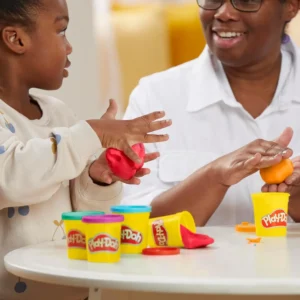
Play-Doh
LEGO free build is another great open-ended activity. ADHD kids often hyperfocus beautifully when given this kind of freedom.
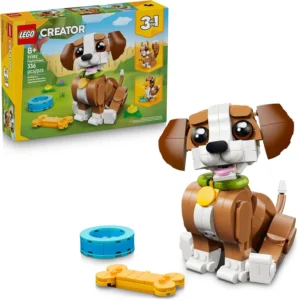
Lego Creator 3-in-1
Skye has been hyperfixated on cutting activities lately. Initially I had a giant roll of craft paper, but it was extremely messy, and it felt wasteful, so I gave her magic air dry clay instead. I know it sounds weird, but the activity is less about crafting, and more about the cutting action. It might be a sensory thing for her, I’m not sure, but with the clay she cuts, cuts, cuts, and then rolls it back into a ball and starts cutting again.
Magic Air Dry Modelling clay is also a creative outlet where kids can build animals, or objects, which solidify after a few hours. You can make play figurines or cute keepsakes
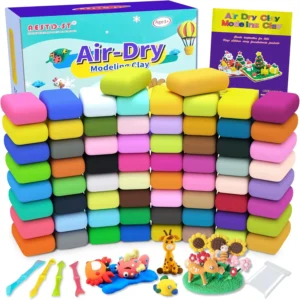
Magic Clay
Movement Activities
Folding Gymnastics or Tumbling Mats. Skye is currently obsessed with handstands, which tells you everything you need to know about her hyperactivity levels. A folding tumbling mat gives kids a safe surface for cartwheels, forward rolls, handstands, and whatever else they’re going to attempt whether you buy a mat or not.
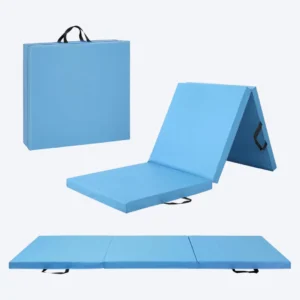
Kids Gymnastics Fold out Mat
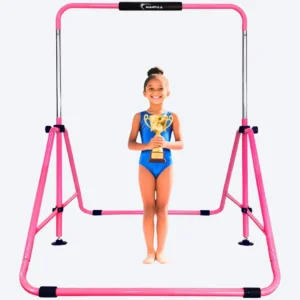
Foldable Gymnastics Bar
Dance breaks such as Zumba Kids or a simple freeze dance game on YouTube does wonders for regulation. Two minutes of full-body movement before sitting down to homework shifts something neurologically that the ADHD brain responds to very well. We do it most days and it costs nothing. Search ‘freeze dance for kids’ or ‘Zumba kids YouTube’ and you’ll find hundreds of free options that work for any age.
Alongside these activities we also try to get a family walk in every evening. Where we live it’s extremely warm, so we’d have to wait for it to cool down a bit. If it get’s too late in the evening we’ll give it a skip, because I won’t budge on our night routine and strict bed time.
Build An After School Routine That Works for You
Every family is different, and some of this won’t fit your afternoon. But the principle underneath all of it is the same: the after school hours need to be a recovery period before they can be a productive one. Fighting that order doesn’t work and we tried for long enough to know.
I would say the main things to focus on are to follow your childs direction and read their moods. Don’t push conversations too much, and let them have their quiet time to decompress.
Keep instructions and direction to a minimum. Set out one or two after school chores or rules that are non-negotiable, before moving into free play or TV time. This signals that school is over, and they’re now moving into their after school routine.
Prioritise movement, especially if you have a hyperactive ADHD kid like I do. And where possible, do this before moving on to homework, to help them focus better.
And last but not least, SNACKS! High quality, high protien snacks! It will help with moodiness, regulation, and focus throughout the afternoon.
Hope that’s helped! I’d love to hear more baout your routines in the comments down below