
This post may contain affiliate links. Disclosure here.
I am not a medical professional. Everything I share here comes from lived experience parenting our daughter Skye, who was diagnosed with moderate to severe ADHD at four. Always consult your child’s doctor before making any changes to medication routines or treatment plans.
If you’ve ever Googled “ADHD morning routine” hoping someone would hand you a perfectly timed schedule that fixes everything, I get it. I’ve been there. I’ve saved the Pinterest graphics, printed the visual timers, downloaded the templates.
But here’s what I’ve learned after years of trial, error, and more than a few very loud 6am arguments: there is no universal ADHD morning routine. There are only the things that work for your kid, in your home, right now. And those things will probably change.
What I can offer you is what honestly works for us, including the parts that didn’t work first, and why we changed them.
Our Morning in Context
Skye needs to be out the door by 6:30am. That means we’re waking up at 5:45, which is brutal, and I won’t pretend otherwise. Early starts with an ADHD child who is already a poor sleeper require a level of planning that starts the night before.
If you’re reading this bleary-eyed at 5:50am, firstly: I see you. Secondly: it does get easier.
Start the Night Before
I cannot overstate how much our evening routine protects our mornings. We treat it as non-negotiable.
Our evening looks like this: Early dinner, screens off an hour before bed, bath, school clothes laid out and ready for the next morning, a short story, and lights out at a consistent time. We are strict about bedtime because Skye is already a light and disrupted sleeper, waking up at least once most nights, so we have to make sure she’s getting every possible minute of rest available to her.
I wrote more about how we’ve set up our home environment to support Skye’s ADHD in this post if you want to go deeper on the physical setup side of things.
The Medication Question and The Early Bird Technique
This one is worth its own section because it made a significant difference for us and I don’t see it talked about enough.
We used to give Skye her medication after breakfast. The mornings were argumentative and hard to manage, which makes sense in hindsight, because we were asking her to navigate the most demanding part of the day before the medication had any chance to work.
We then moved to giving it as soon as she woke up, with a glass of milk. That helped. But we’ve recently been experimenting with what the ADHD parenting community calls the Early Bird technique, giving the medication approximately an hour before wake-up time, without fully waking the child. Skye goes back to sleep easily, and when she wakes up, the medication has already begun working.
The difference in those first 20 minutes of the morning has been noticeable.
I want to be really clear here: this is not something to try without speaking to your child’s doctor first. Medication timing is individual and needs to be monitored carefully. What works for Skye may not work for your child, and some medications are not suitable for this approach at all.
But if mornings are consistently the hardest part of your day, it’s worth raising with your child’s doctor as an option.
Our Actual Morning Routine
5:45am – Wake up
On Early Bird days, medication is given around 4:45am and Skye goes back to sleep easily enough.
Downstairs for breakfast. Skye has a low appetite in the mornings, this is a common medication side effect, so we prioritise foods she’ll actually eat. Most days that’s cornflakes without added sugar. We also try to include protein where we can: a boiled egg on the side, or peanut butter toast. Getting something substantial into her before school matters for her concentration and regulation, so we work with what she’ll actually eat rather than fighting over it.
Vitamins and supplements with breakfast.
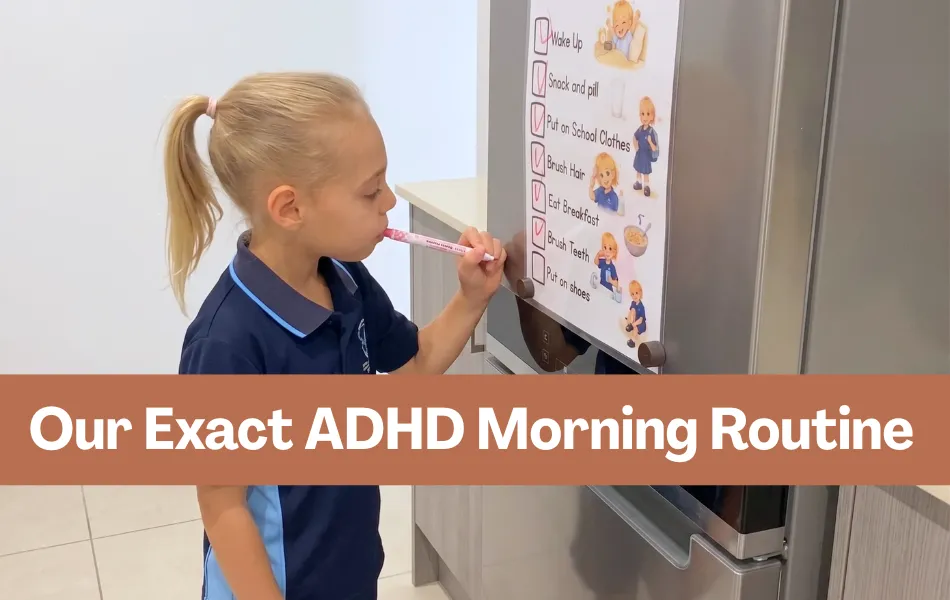
Then she follows her routine chart independently.
The System That Changed Everything – Our Visual Routine Chart
We tried visual timers. Skye found them anxiety-inducing. The ticking, the shrinking colour, the visible countdown, rather than helping her feel organised, it made her feel rushed and panicked so we let that go.
What has worked is a simple visual routine chart with a sticker reward system. Each morning task has its own step and when she completes it, she places a sticker. When all her boxes are filled across the week, she earns a reward of her choice.
The key shift was for her to manage the chart independently. We are not standing over her directing each step. She knows the order, she knows what’s expected, and she moves through it herself. On good days it runs smoothly, and on harder days, when she’s being defiant or dysregulated, we step in and help without making it a confrontation. The goal is always a calm exit out the door, not a perfectly independent one.
I follow what I think of as a “trying beats done” approach. As long as she’s working through her routine and making the effort, I’m happy. We’ll help with getting dressed if we need to and we’ll intervene if something is escalating. But Skye now brushes her teeth and puts her shoes on without any resistance at all, and six months ago that felt impossible.
We’ve made our visual routine board available as a free download below. It’s the exact one Skye uses, and you can customise it in Canva to suit your child’s specific routine.
A Note on Time Management
If you are looking for a timestamped schedule i.e 5:45 wake up, 5:50 medication, 5:55 breakfast, 6:10 teeth, I understand the appeal. But I’d gently push back on that approach for most ADHD families.
ADHD mornings have variability built into them. Some days Skye moves through her routine in twenty minutes and some days we need every minute of the forty-five we’ve built in. A rigid timestamp creates a failure condition every time something takes longer than planned.
What works better for us is building in buffer time and managing it ourselves. We know we need to leave by 6:30 and we know there will probably be one or two hiccups, so we start early enough to absorb them. We do the mental time management quietly as parents, without broadcasting a countdown to Skye, and let her work through her chart at her own pace within the window we’ve created.
What Doesn’t Work (For Us)
Since I think the honest list is as useful as the tips:
- Visual countdown timers — created anxiety rather than urgency for Skye
- Giving medication after breakfast — too late in the morning to make a difference
- Too many steps on the routine chart — we started with 10 tasks and she felt overwhelmed. We cut it to 7 and it immediately went better
- Arguing about getting dressed — we let this go. We help when needed and save our energy for the battles that matter
- Expecting perfect independence — some mornings she needs more support and that’s okay
Our ADHD Morning Routine at a Glance
The night before: Early dinner → screens off → bath → school clothes laid out → story → consistent bedtime
Morning: 5:45am wake up → breakfast (cereal + protein where possible) → vitamins and supplements → routine chart → medication if not already given → teeth → pack lunch → shoes → out the door by 6:30am
The Honest Truth
Some mornings are still hard. Some mornings someone cries (occasionally that someone is me). But the foundation of a consistent routine means that even our hard mornings are more manageable than they used to be, because everyone knows what’s coming and there are fewer surprises to navigate.
If you’re just starting out with an ADHD morning routine, start smaller than you think you need to. One or two consistent anchors such as medication timing, a simple chart, clothes laid out the night before, will do more than a perfectly structured 45-step plan that falls apart under pressure.
You can read more about our full journey with Skye’s diagnosis and what we’ve learned along the way here.
And if you want the visual routine board we use, the exact one, with customisable Canva template included, grab it below. It’s free.
What does your ADHD morning look like? Tell me in the comments. The messy version is welcome!